
Evaluating Fragrance Suppliers for a Body Care Line
Working on something between your first million and your first hundred million? We embed at the founder level.
Start a ProjectYou can evaluate a fragrance supplier in a week if you know the five places where weakness shows: the written scope, the batch record, the certificate list, the sample sign-off and the compliance file. Strong suppliers answer all five in a day; weak ones answer around them. The goal is not to find a perfect factory. It is to find one whose process is documented well enough to repeat at volume, because the product follows the process.
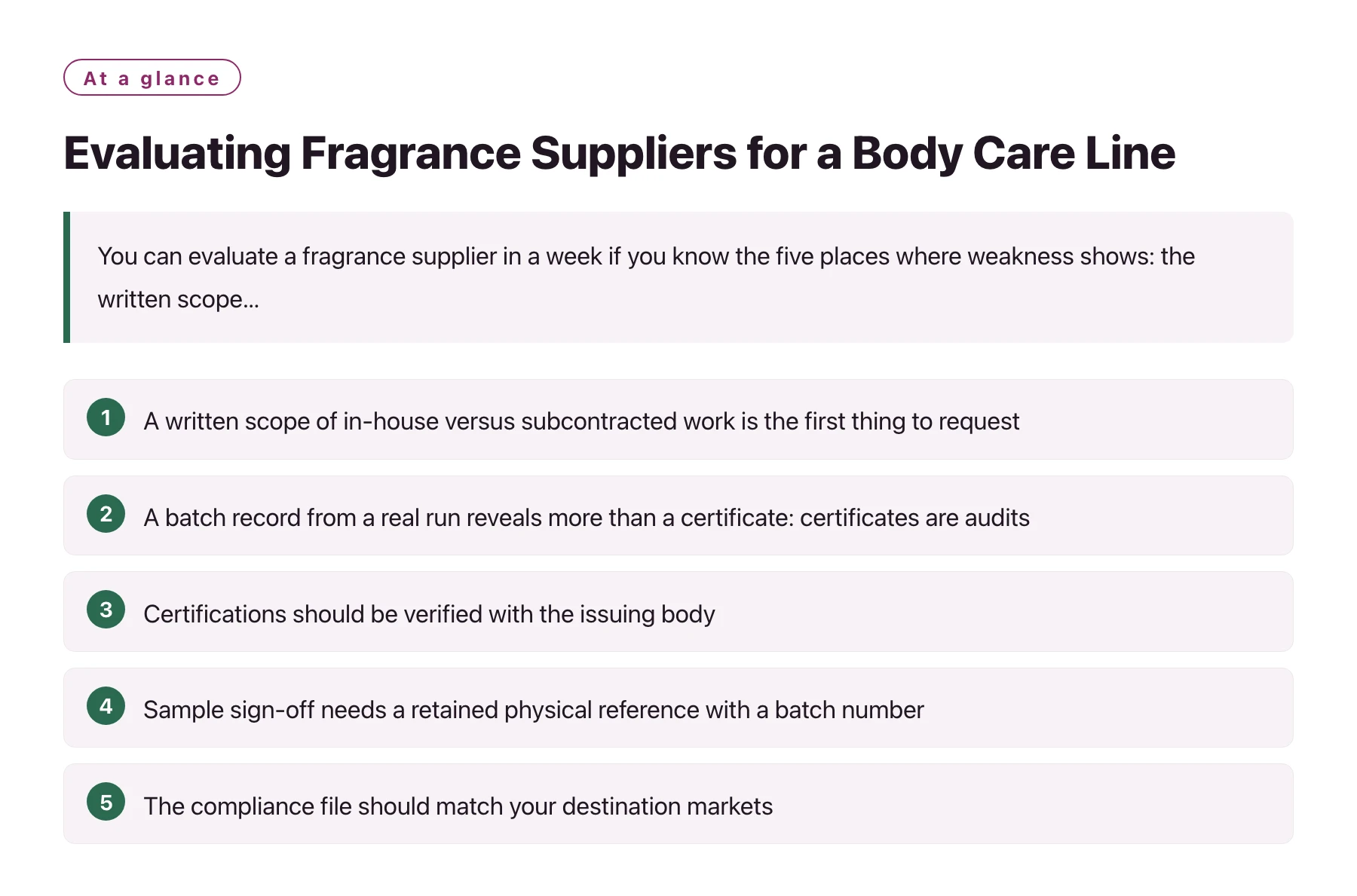
Key takeawaysA written scope of in-house versus subcontracted work is the first thing to request, because it explains the price. · A batch record from a real run reveals more than a certificate: certificates are audits, records are evidence. · Certifications should be verified with the issuing body, not with the sales representative. · Sample sign-off needs a retained physical reference with a batch number, not a photograph. · The compliance file should match your destination markets, so name the markets up front.
Suppliers are easy to find and hard to evaluate, because the difference between a good one and a bad one is invisible until the first bulk run. The good news is that the difference is not secret; it sits in five places that are all checkable.
This article is the checklist a sourcing person would run, written for a body care brand that wants to evaluate without a consultant.
The checks that expose a weak supplier
The six checks below are ordered by how cheap they are to run: the first three are paper checks, the last three are conversations. Run them in that order, because a supplier that cannot pass the paper checks rarely redeems itself in conversation.
1. The written scope
Ask which steps — development, compounding, filling, decoration, testing — happen in house and which are bought in. The answer explains the price, the lead time and the points of failure. A supplier that cannot produce the list in writing has not thought about it.
2. The batch record
Ask to walk through one record from raw material intake to release: lot numbers, weigh-ups, in-line checks, the approved reference. Cosmetics GMP-aligned testing and certification services exist to make that traceability routine, and a supplier that works that way will have the document ready [1].
3. The certificate list
Management-system certificates — for body care look at cosmetics GMP, quality, environment and occupational health — should come with the issuing body and a scope you can verify. The industry body behind fragrance safety standards also tells you which frameworks the maker works inside [2].
4. The sample sign-off
Agree the reference before the sample arrives: a sealed physical sample, held by both sides, with a date and a batch number. Photographs and memories are not reference standards.
5. The compliance file
Name your destination markets and ask what the file will contain for each. If the supplier's file matches your market's needs already, that is operating experience you can see; if it does not, that is work still in front of you.
6. Ownership of the design
If the bottle or the scent identity is your asset, settle the intellectual property in writing. WIPO administers the international routes for registering industrial designs and trade marks, which is only useful if the registration sits with you [3].
Running the evaluation without a consultant
You can pre-filter on public information: location, categories and certifications are usually stated on the maker's own site, so the first cut takes an afternoon.
A maker that publishes this openly, such as Xuelei official site, lets you check scope, certifications and categories before the first call — which is when the expensive mistakes are usually made.
Score what you find against your own brief, not against an ideal factory. A supplier that is average on everything but excellent on your format is usually a better partner than one that is excellent on everything but your format. The evaluation is a fit test, not a beauty contest.
The contract stage
The checks do not stop at evaluation; the contract turns them into terms. the checks that matter before signing a contract walks through the clauses worth settling before the first order — ownership, exclusivity, the test programme and the exit.
Proof of work
Process checks tell you how a supplier works; project history tells you what it has done. Ask what categories it runs regularly, and check the case stories it publishes, such as Xuelei's client stories, against your own format needs.
Weakness is not a personality trait; it is a documentation gap. Every check on this list is answerable in a day by a supplier whose process is written down. Give the supplier that day, and count the days it takes.
Sources
- SGS: Cosmetics, Personal Care & Household Testing —— Testing, inspection and certification services for cosmetics and personal care, including microbiological, stability and safety testing aligned with cosmetics GMP.
- International Fragrance Association (IFRA) —— IFRA is the global trade association of the fragrance industry; its site publishes the IFRA Standards, positions and science on the safe use of fragrance materials.
- WIPO — World Intellectual Property Organization —— The UN agency for intellectual property; resources on industrial design and patent protection relevant to product and packaging design.
Frequently asked questions
What is the fastest way to shortlist fragrance suppliers?
Filter on public information first: location, categories served and published certifications. Then send the same written brief to three candidates and compare their scope lists and answers line by line.
Do certificates prove quality?
No. A certificate proves a management system was audited at a point in time; a batch record proves what happened on a specific run. You need both, and the certificate should be verified with the issuing body.
Should I visit the factory before the first order?
A visit is valuable but not the fastest filter. Run the five checks on paper first, then use the visit to look at the places the paper cannot describe: the line, the retained samples and the paperwork on a real batch.
What is a batch record and why does it matter?
It is the written trace of one production run: raw material lots, quantities, checks and the reference sample it was made against. Without it, your product cannot be audited, reproduced or recalled cleanly.
How many suppliers should I evaluate?
Three is enough to see how the market answers the same brief, and few enough to keep the comparison honest. Send an identical brief to each so the differences you see are real differences, not different briefs.