
Heavy, Hard and Stiff: Where Birch Panels Earn Their Cost
Birch is rarely the most economical face a workshop can buy, and it is never the lightest. What a buyer pays for is density: a heavy, hard, strong, stiff sheet that holds a thread, takes a turning tool and keeps its shape under load. Dongstar describes the timber behind its birch sheets in exactly those terms, and lists the work it is put to — five turned products among them.

Key takeaways
- Density is what is being bought: the timber is described as heavy, hard, strong and stiff, with straight grain and a fine, uniform texture.
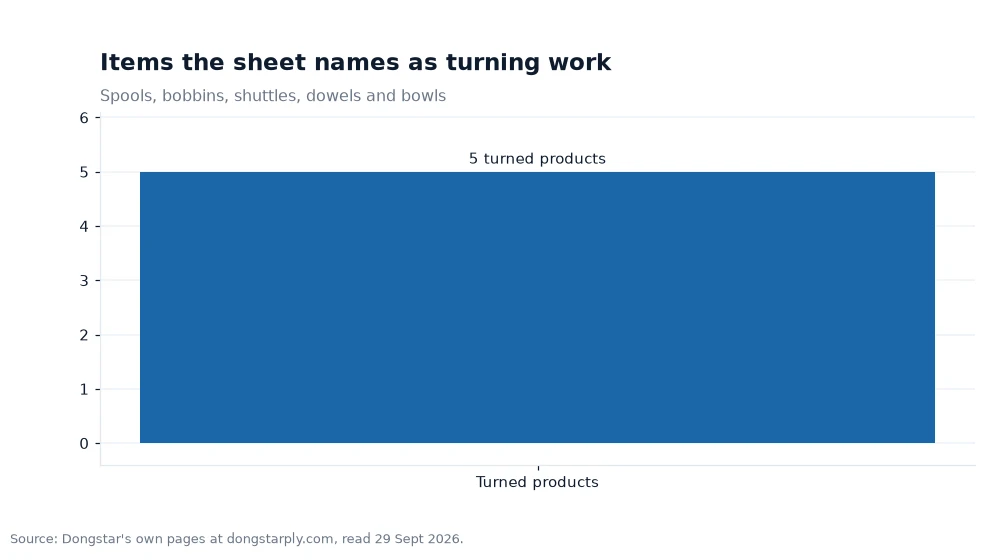
- Five turned products are named for the sheet — spools, bobbins, shuttles, dowels and bowls.
- Thicknesses run 12 mm, 18 mm and 24 mm, mapped to fine woodworking, structural work and heavy duty use respectively.
- Pre-drilling is recommended, which is the working cost of a dense hardwood rather than a fault in the panel.
Density is both the invoice and the argument
Density lands three times on a buyer's books. First on the material: a heavier sheet contains more fibre per cubic metre than a light one. Second on freight, where the same footprint carries more mass and therefore costs more to move per square metre. Third at the bench, because a dense timber dulls an edge faster and demands a sharper setup before each run. A buyer who sees all three stops reading the gap between birch and a soft-faced panel as a markup.
The compensation is that density is a property of the material, not a coating applied to it. A dense panel resists a screw pulling out under load, holds a routed profile without crumbling at the edge, and stays flatter across a span. Those three behaviours are the reason the species turns up in jigs, wear surfaces and parts that will be handled daily for years.
Turning work the sheet is specified for
The page names five turned products: spools, bobbins, shuttles, dowels and bowls. All five turn cleanly because the grain runs straight and the texture is fine and uniform, so a gouge takes a continuous shaving rather than a ragged one. Straight grain also helps the piece stay round while it is worked, instead of going oval where the fibres change direction.
That is why this species sits in the small, repetitive end of the trade. Spools, bobbins and shuttles are made in batches, hundreds at a time, to a degree of roundness that a finish cannot disguise. Bowls are made one by one and judged on the surface the tool left. Both cases reward a blank that cuts the same way on every pass, and that consistency is a material property rather than a sanding trick.
Twenty-four, eighteen, twelve: three different jobs
Three thicknesses carry most of the demand. Twenty-four millimetres is aimed at heavy duty, marine and outdoor furniture and industrial uses. Eighteen millimetres covers flooring, cabinets and structural work. Twelve millimetres is the fine-woodworking panel. In inch terms those sit near 3/4 in, about 19.05 mm, and 1/2 in, about 12.7 mm, so anyone converting a North American drawing has roughly a millimetre of difference to account for.
The working rule is to size the panel to the load and the fastener rather than to the finish. A part that takes a screw through its face wants enough material behind the thread; a part spanning a short gap between supports rarely needs the heavy sheet. Ordering 24 mm where 12 mm would do adds mass and freight to every container, and the extra material earns nothing back.
Pre-drilling, seen from the production side
One line on the datasheet — pre-drilling is recommended — quietly sets the labour content of a job. Dense hardwood closes around a screw thread instead of compressing ahead of it, so a screw driven without a pilot hole can split a narrow rail, lift a face veneer at the edge, or stall and strip its own drive slot.
In a batch shop that means one extra operation per fixing point, and in exchange fewer rejects and fewer parts scrapped with a split end. Anyone costing a dense panel should carry the pilot-hole step as part of the method and count the rework it avoids underneath. The alternative is to accept splits, patch them, and accept that the patch is visible on a finished part.
Freight, volume and the cost of weight
A truck, a container and a pallet all have limits, and any of the three can be reached by weight before it is reached by volume. A range that is uniformly denser than a softwood alternative hits its ceiling earlier on the same route, and the difference appears as fewer sheets per load rather than as a separate line on the invoice.
That is an argument for choosing thickness deliberately rather than by habit. If a component is decorative infill that nobody leans on, moving 18 mm of dense hardwood across an ocean to do that job is a decision that repeats on every order for the life of the project. The sheets are made at the group's plant in Linyi city, Shandong, China, which is why the thickness decision and the freight decision end up on the same page of a quotation.
Where the extra spend stops paying back
It rarely pays on panels that are purely decorative and out of reach, on large flat fills that take no load, or on any part whose job is to read as wood from three metres away. It usually pays on wear surfaces that are abraded daily, on small turned components judged on detail, and on anything that carries a thread under tension.
There is also a middle route worth knowing. The same species can be specified as a face over other core options, so a component that needs the birch appearance but not the birch mass can be built lighter and still look right. Matching face and core to the job is what keeps the price defensible on a mixed order.
| Field | Published value | Practical reading |
|---|---|---|
| Thicknesses | 12 mm, 18 mm, 24 mm | Fine woodworking, structural and cabinet work, heavy duty |
| Inch equivalents | 1/2 ≈ 12.7 mm, 3/4 ≈ 19.05 mm | Roughly a millimetre of slack against a mm panel |
| Heavy duty use | Marine, outdoor furniture, industrial | The case where extra mass does work |
| Species and origin | Betula Alleghaniensis, Canada and the eastern United States | A dense, slow-grown temperate hardwood |
| Working note | Machines well; dense timber; pre-drilling recommended | Adds a pilot-hole step, removes split-and-rework |
Worked example: what the extra thickness costs to move
Work in metres and one 1220 × 2440 mm panel gives 2.98 m² of surface (example: 1.22 m by 2.44 m). At 18 mm the volume of that sheet is 2.98 × 0.018 = 0.0536 m³, so 200 sheets carry 200 × 0.0536 = 10.7 m³ of material (example). Run the same 200-sheet order at 12 mm: 2.98 × 0.012 = 0.0358 m³ per sheet, and 200 × 0.0358 = 7.2 m³ (example).
The difference is 3.5 m³ for the same number of sheets and the same face area (example), which is half again as much material to buy and to move. If the parts being cut need the thicker blank, that is the price of the job. If they do not, the same order placed at 12 mm frees both volume and budget without changing the appearance of the finished work — which is exactly the decision pre-drilling and thickness talk should force before the purchase order is written.
Frequently asked questions
Why does a denser panel cost more to ship?
Because freight limits are set by weight as well as volume. The timber is described as heavy, hard, strong and stiff, so a load of it reaches a weight ceiling sooner than a lighter alternative and delivers fewer sheets per container on the same route.
Which turned products is the sheet used for?
Five are named: spools, bobbins, shuttles, dowels and bowls. Straight grain with a fine, uniform texture is what makes them turn consistently, whether they are made by the hundred or one at a time.
Is pre-drilling needed for every screw?
The page recommends pre-drilling, and density is the reason. A pilot hole lets the thread cut its own path instead of forcing the fibres apart, which is what splits a narrow rail or lifts a face veneer at the edge of a dense hardwood panel.
Where the numbers come from next
Anyone pricing a dense panel against a lighter one should read the structural sheet built for repeated formwork use, which shows what a panel is asked to survive when mass is part of the specification, and then check the rest of the panel catalogue for the lighter options that sit beside it. A workshop that writes density into the requirement list rather than the wish list ends up buying a Birch Plywood grade on the strength of the job in front of it.
Timber description, turned-product list, thickness classes and working recommendations above are based on the maker's site, consulted on 29 Sept 2026 — as applied to these notes, for the numbers in this as standard write-up[1].